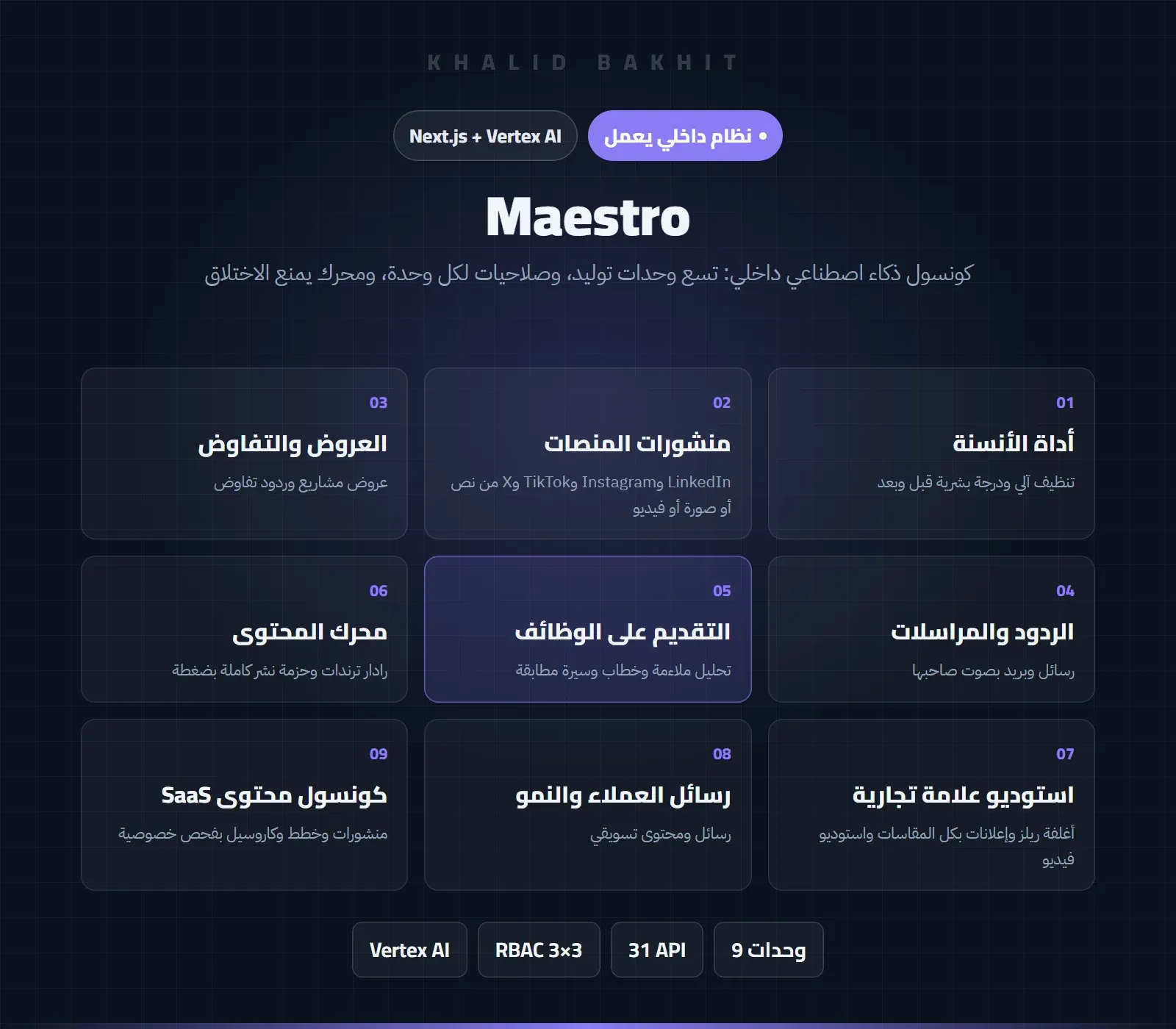
Maestro an internal AI console with nine generation modules, per-module permissions and an engine that blocks invention
Nine AI tools for one team in one place: posts, proposals, CVs, content and video, with every text passing through a humanizer engine.
- 9
- generation modules
- 31
- API routes
- 20K
- lines of TypeScript
- 3×3
- roles × permission levels
The problem
The team jumped between scattered tools and chat windows, rewrote the same instructions every time, and the output was easy to spot as generated. There was no way to know who was using what.
Overview
Maestro is an internal console I built on Next.js and Vertex AI that gathers specialised generation modules into one app. Each team member signs in with Google and sees only the modules they are allowed to use. It has been in production since June 2026 and the team uses it daily on real client content.
What I built
- A posts module for LinkedIn, Instagram, TikTok and X that writes from text or from an uploaded image or video
- A job-application module: fit analysis, a cover letter, an answer for every field and a printable CV tailored to the posting
- A content engine with a multi-source trend radar that builds, in one click, a post with three hooks, an article with structured data, a carousel PDF, an Arabic version and a cover image
- A virtual video studio: one phone clip becomes a reel with several framings, stabilisation, colour correction and podcast-grade audio
- A carousel designer with seven designs, and a caption and music studio shared across modules
- Permissions with 3 roles and 3 levels per module, checked on the server at every API route
The engineering call
The CV is stored as structured data with an id on every item. The model does not write the CV; it returns a plan of ids only, and the code applies it, rejecting any unknown id or unrecorded skill and showing what it rejected. I tested it with a deliberately poisoned plan, and it was rejected item by item.
Inside the project
The system is internal, behind sign-in, and works on real client content, so these images are explanatory diagrams rather than screenshots.